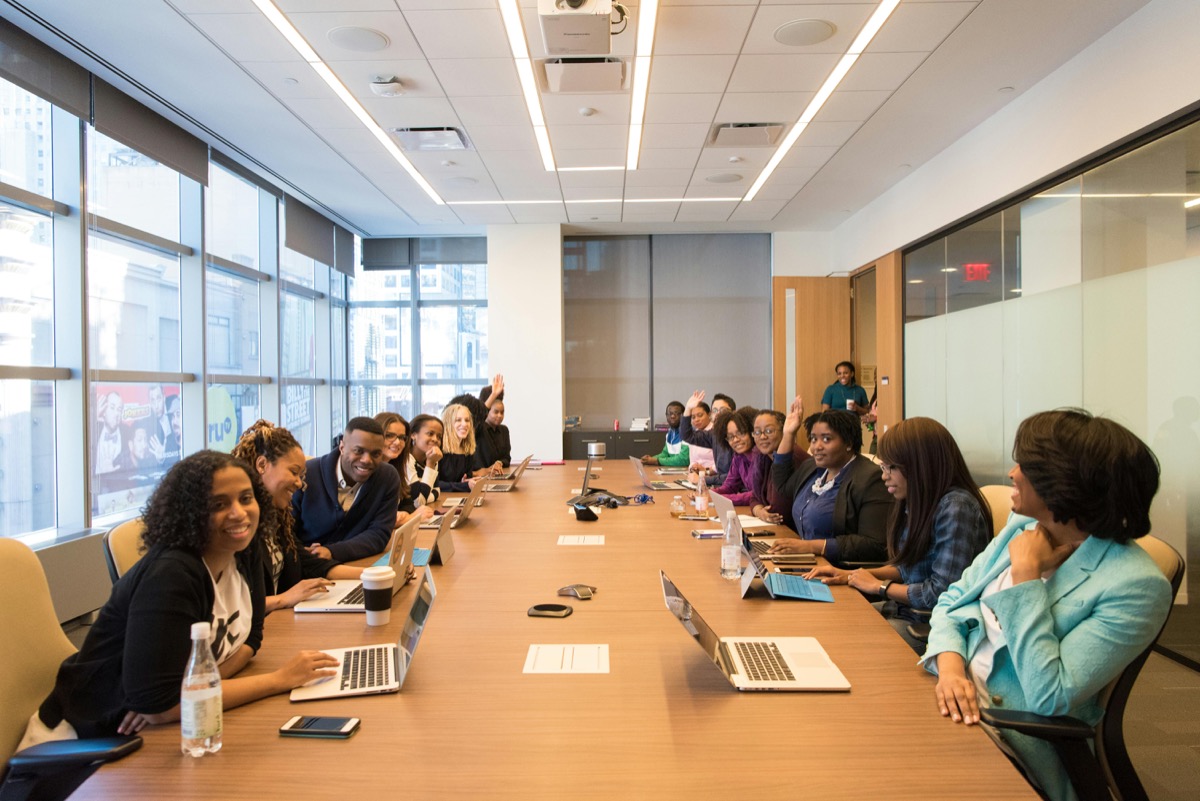
Featured image: A diverse group of professionals engaged in a productive meeting around a conference table. Photo by Christina Morillo on Pexels (Free to use).
In 2026, 78% of organizations worldwide have integrated AI into their daily operations, and the economic impact of AI is projected to reach $15.7 trillion by 2030 according to PwC estimates — making this the single largest economic transformation in modern history. But more telling than these headline numbers is how AI is redefining the fundamental relationship between people and organizations — across communication, individual capability, employment structures, and the very existence of the HR function.
This is not a speculative piece about the distant future. The future is already here, unevenly distributed. This article examines five structural shifts already reshaping global human resources under AI.
The stakes are enormous. Global workforce participation is being reshaped by tectonic forces: 78% of organizations now use AI daily, the freelance economy has absorbed 29.8 million solopreneurs in the US alone, and AI recruitment tools process millions of candidate profiles per day. Understanding how these shifts interact is not an academic exercise — it is the difference between building a talent strategy that works in 2030 and one that is obsolete by 2027.
AI Is Dismantling Language Barriers — So Why Do Culture Barriers Persist?
AI translation tools like DeepL and ChatGPT have made staggering progress in the past two years. The AI translation market is now valued at $3.5–$4 billion in 2026, and real-time voice translation products such as DeepL Voice have entered enterprise deployment. Panasonic Connect, after deploying DeepL, saw significant improvements in cross-team communication efficiency — switching between Japanese and English now requires almost no wait time.
Yet global teams are far from having solved their communication problems.
A study published by Appen in February 2026 found that even the most advanced large language models still struggle with idioms, puns, and figurative language — the cultural dimension of translation. AI can translate the literal meaning, but it cannot grasp why a particular expression fits a specific social context. The deep rules of culture — power distance, high-context versus low-context communication, attitudes toward time, decision-making norms — create gaps that no amount of linguistic accuracy can bridge.
A Japanese team member says “I will consider it” in perfect English. The AI translation is flawless. But a manager unfamiliar with Japanese communication norms may not know this is a polite decline. Conversely, a US colleague delivers direct feedback, accurately translated into Japanese, yet the Japanese team perceives it as rude.
Language is surface-level. Culture is embedded. AI removes the wall of “speaking” but not the wall of “understanding.” This means the value of learning a foreign language has not disappeared — it has shifted from “being able to communicate” to “being able to interpret.” AI gets you past grammar and vocabulary; you still need to navigate context and unspoken norms. In 2026, the most valuable employees in multinational companies are not the most fluent speakers — they are the ones with the strongest cultural adaptability.
Global companies are responding by redesigning their cross-cultural training programs. Rather than teaching language phrases that AI can now handle, leading firms invest in cultural context workshops: understanding high-context versus low-context communication styles, navigating hierarchical decision-making norms, and recognizing indirect feedback patterns across regions. Japan’s Recruit Holdings, one of the world’s largest HR technology companies, has integrated cultural competence metrics into its global leadership development framework. The shift mirrors what the AI Adoption Report 2026 documents across industries: as AI handles routine execution, the premium on distinctly human capabilities — in this case, cultural interpretation — rises correspondingly.
How Are One-Person Companies and Super Individuals Reshaping Employment?
AI’s most profound impact on organizational structure is the exponential amplification of individual output.
The United States is home to 29.8 million solopreneurs, contributing $1.7 trillion to the economy — 6.8% of total U.S. economic activity. According to the SBA, over 80% of small businesses in America have no employees. This is not a byproduct of economic hardship. It is a structurally driven transformation.
Pieter Levels runs three product lines — Photo AI, Remote OK, and Interior AI — generating over $3 million in annual revenue with zero employees. Danny Postma built HeadshotPro to $1 million ARR in its first year, operating solo. Marc Luo crossed $1 million in total revenue across a portfolio of a dozen micro-SaaS products by 2025. These are not isolated outliers. The solo developer economy is becoming one of the most significant economic trends of 2026.
The underlying economics are straightforward. An AI agent stack costs under $300 per month and can replace what once required a team of 2-3 engineers, a designer, a marketer, and a customer support rep. Gross margins above 95%, monthly operating costs of $400–500, and the ability to sustain $10K+ MRR as a single operator — this equation did not exist before 2020.
What does this mean for HR? The employment structure of the future will feature a “third pole” — neither full-time employee nor short-term contractor, but the long-term collaborating super individual. These individuals form deep working relationships with companies outside the constraints of traditional employment. They may serve 3-5 companies simultaneously, each relationship far exceeding the shallow engagement levels of traditional freelancing.
Freelance economy data shows that 78% of freelancers now use AI tools to boost productivity, and 52% say AI helps them complete projects significantly faster. Companies report a 34% productivity improvement from AI-enabled freelance work. When individual output, amplified by AI, approaches that of a small team, corporate talent strategy shifts from “how many people do we hire” to “who do we collaborate with.”
This shift forces HR departments to develop entirely new engagement models. Traditional freelancer management — short-term gigs with minimal integration — gives way to long-term collaborative partnerships that require onboarding, performance management, and cultural integration for people who never appear on the payroll. Companies like Deel and Remote.com have built platforms specifically for this emerging employment category, handling compliance, payments, and benefits across 100+ countries. The HR function’s role expands from managing employees to orchestrating a mixed workforce of full-time staff, long-term collaborators, and AI agents — each requiring different management approaches and legal frameworks. For solo entrepreneurs looking to thrive in this new landscape, the AI Solo Entrepreneur Guide 2026 provides a practical roadmap.
How Will Recruitment Change: From Funnel to Marketplace
Traditional recruitment is a funnel: company posts a requirement → screens resumes → interviews → hires. It is a one-way, employer-driven linear process.
AI is reshaping this into a two-way marketplace.
In 2026, 84% of hiring processes now use AI. AI matching platforms reduce time-to-hire by 40% while improving candidate quality. Platforms such as SmartRecruiters’ Winston Match, Cadient, and Rival Recruit now deliver skills-based intelligent matching — not keyword matching on resumes, but analysis of candidate capability profiles, career trajectories, and hidden skills, producing transparent match scores.
This shift operates on three levels.
Level one: from HR screening to AI pre-screening. HR professionals spend 57% of their working week on administrative tasks, a large portion of which is resume screening and candidate communication. When AI handles the initial filter, HR’s role shifts from “the person who screens resumes” to “the person who designs the screening strategy.”
Level two: from company-chooses-candidate to two-way matching. When AI eliminates information asymmetry — candidates can see company culture, team composition, and promotion data as clearly as employers see their profiles — choice becomes mutual. Companies interview candidates while candidates use AI to analyze whether the company fits them.
Level three: from company-provided training to individual-driven growth. 92% of employers now prioritize validated skills over degrees, expanding the talent pool by 19x. When skills matter more than credentials, the individual’s growth path shifts from “the company arranges my training” to “I choose what to learn and prove it through results.” LinkedIn data shows that self-directed learners spend 72% more time on content they actively seek versus content assigned by employers. AI-powered personalized learning platforms accelerate this trend — employees no longer wait for their company to provide training.
The two-way marketplace has implications beyond speed and efficiency. It fundamentally shifts power from employers to talent. When candidates can analyze salary benchmarks, company culture ratings, career progression data, and team composition before applying, the traditional asymmetry that favored employers collapses. Companies that previously relied on opaque recruitment processes now find themselves evaluated as thoroughly as they evaluate candidates. Early adopters of transparent hiring — posting salary ranges, sharing team demographics, and publishing promotion velocity data — report 40% higher offer acceptance rates and stronger long-term retention.
Bias mitigation remains the critical challenge. AI matching systems trained on historical hiring data can perpetuate or amplify existing biases around gender, race, and age unless deliberately designed otherwise. Singapore’s Infocomm Media Development Authority has published mandatory bias testing guidelines for AI recruitment tools, and the EU AI Act classifies employment-related AI as high-risk, requiring conformity assessments. HR’s role in 2026 increasingly centers on algorithmic audit — not building AI tools, but ensuring they produce fair outcomes across demographic groups.
Will HR Departments Exist When AI Automates Most HR Work?
This may be the most unsettling question for HR professionals — and the one most worth answering honestly.
Deel’s research shows that HR professionals spend 57% of their working week on administrative tasks. Workwize’s research further indicates that HR teams’ administrative workload has surged over the past three years while headcount has barely moved. Forrester finds that HR automation reduces new hire time-to-productivity by an average of 23%.
So what happens to HR when that 57% is automated?
The answer is that HR’s form will change fundamentally, but its function will not disappear.
The likely evolution path looks like this:
Administrative layer (2026–2028): full automation. Payroll calculation, attendance management, onboarding, offboarding, benefits administration, records maintenance — all can now be automated end-to-end. AI agents handle employee inquiries 24/7, auto-approve leave requests, and generate compliance reports. This layer no longer requires dedicated HR staff.
Recruitment and matching layer (2028–2030): AI-led, management-decided. AI completes resume screening, candidate matching, initial communication, and even structured interviews. Final hiring decisions shift from HR departments to business line managers. HR’s role evolves from “executor” to “process designer” — ensuring AI matching parameters are well-calibrated, algorithms are free from bias, and candidate experience meets standards.
Strategic layer (2030+): a network of part-time HR specialists. When administration and recruitment are both highly automated, companies no longer need standing HR departments. What replaces them is a network of on-demand HR experts — organizational development consultants, compensation strategists, culture designers, labor relations specialists. They serve multiple companies on a project or part-time basis, much like external legal counsel today. Management focuses on “selecting people,” AI handles “managing people,” and HR experts focus on “designing the system.”
Already, 61% of business leaders believe AI will eventually take over most HR functions. The question is not whether, but when and at what speed.
Early evidence from companies at the forefront of HR automation supports this trajectory. Unilever’s internal AI-powered talent marketplace now matches employees to internal opportunities based on skills rather than job titles, reducing external hiring costs by 30%. IBM’s AI-based retention prediction system identifies flight-risk employees with 95% accuracy, enabling proactive intervention. These are not experimental projects — they are production systems running at enterprise scale. The pattern is consistent: AI does not eliminate the need for human judgment in HR; it shifts that judgment from routine decisions to strategic design choices.
What Does This Mean?
So back to the original question: under the spread of AI, what will global human resources look like?
Language barriers are crumbling, but cultural adaptability becomes the new scarce resource. One-person companies and super individuals are rising, redefining who counts as an “employee” — the talent structure shifts from a pyramid to a network. Recruitment transforms from one-way selection to a two-way marketplace, with power moving from HR departments to individuals. And the HR function itself evolves from a departmental silo into a hybrid of AI infrastructure and an expert-on-demand network.
For individuals, this may be the best era in history: AI gives you tools to transcend language barriers, leverage to amplify your output, and direct access to opportunities without intermediaries. For companies, it demands a complete rethinking of the people-organization relationship — you no longer own a team, you connect to a talent network.
2026 is just the beginning. By 2030, these trends will be fully realized. Every HR professional, business leader, and working professional needs to answer one question: when AI can do most of what HR does today, where is your irreplaceable value as a human being? For organizations, the answer increasingly lies in culture building, strategic judgment, and the inherently human work of connecting people to purpose — tasks no algorithm can delegate.
For HR professionals specifically, the path forward requires three strategic shifts. First, move from process execution to system design — stop being the person who processes payroll and become the person who designs how compensation philosophy aligns with business strategy. Second, develop AI literacy that goes beyond using the tools to understanding their limitations, bias potentials, and appropriate application boundaries. Third, rebuild the function around measurable outcomes — employee retention, culture health, leadership pipeline strength — rather than activity metrics like time-to-fill and resumes screened. The organizations that navigate this transition successfully will be those that treat AI not as a threat to their HR function but as the catalyst that finally frees human resources professionals to do genuinely human work. For a deeper analysis of how the broader employment landscape is being reshaped, see our report on whether you still need to hire experts in the AI era.